Confession of a kidnapper
Date Published
: Traditional
: Scattered Legacy
During the so-called Arrow War (aka 2nd Opium War) British forces occupied Canton (Guangdong 廣東) in 1858 and ransacked the Yamen of Governor Yeh. In the process they purloined a large number of documents that eventually found their way into the British National Archives where they are catalogued as the Canton Archives FO 931.
Below is a translation of FO 931/1864. It is a confession of a kidnapper that tells us much about the methods, the link with foreign buyers (French in this case) and even refers to a "Gold Mountain" person, that is, someone who had been in California or possibly even the Colony of Victoria.
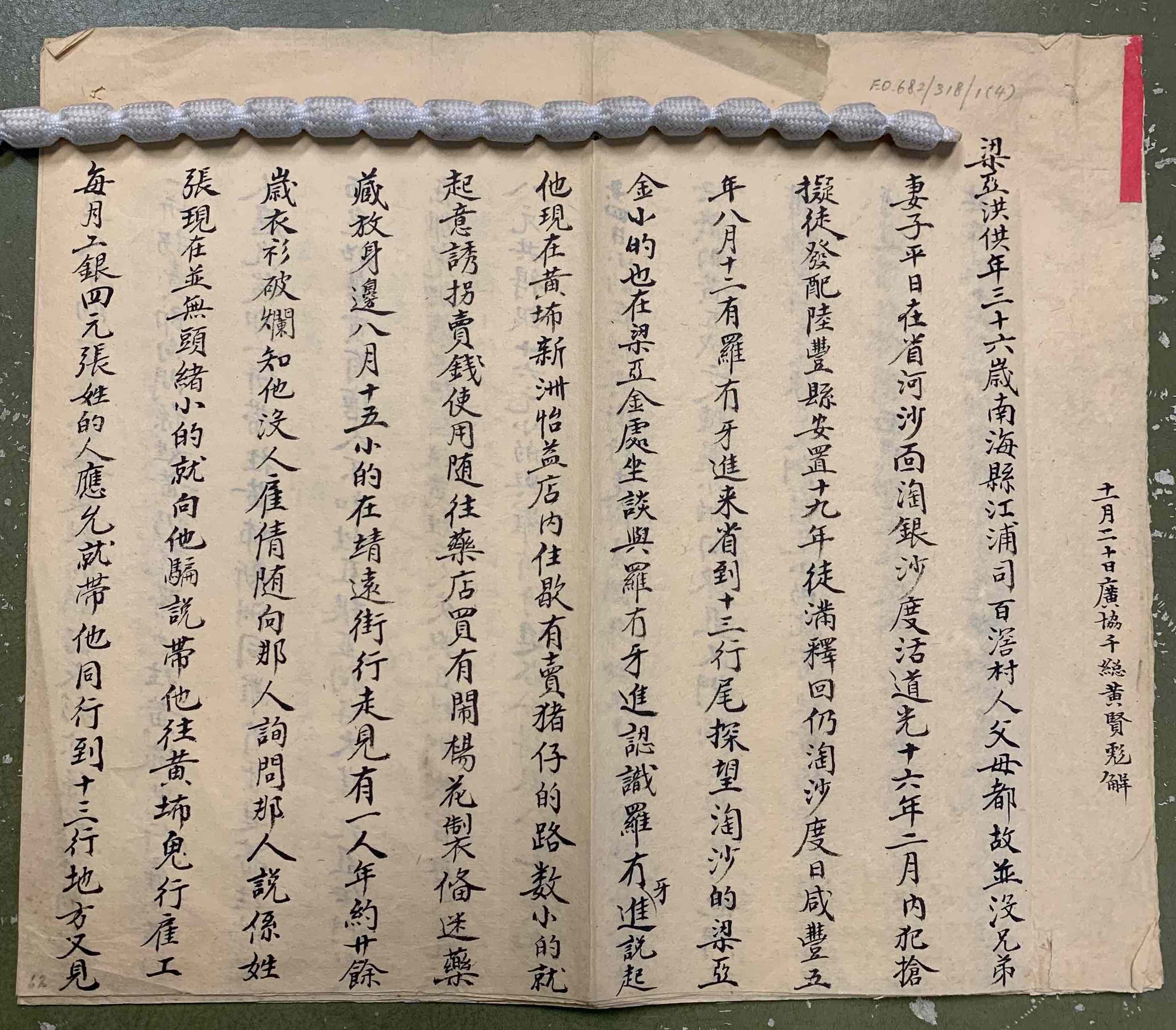
Confession of a kidnapper, p.1
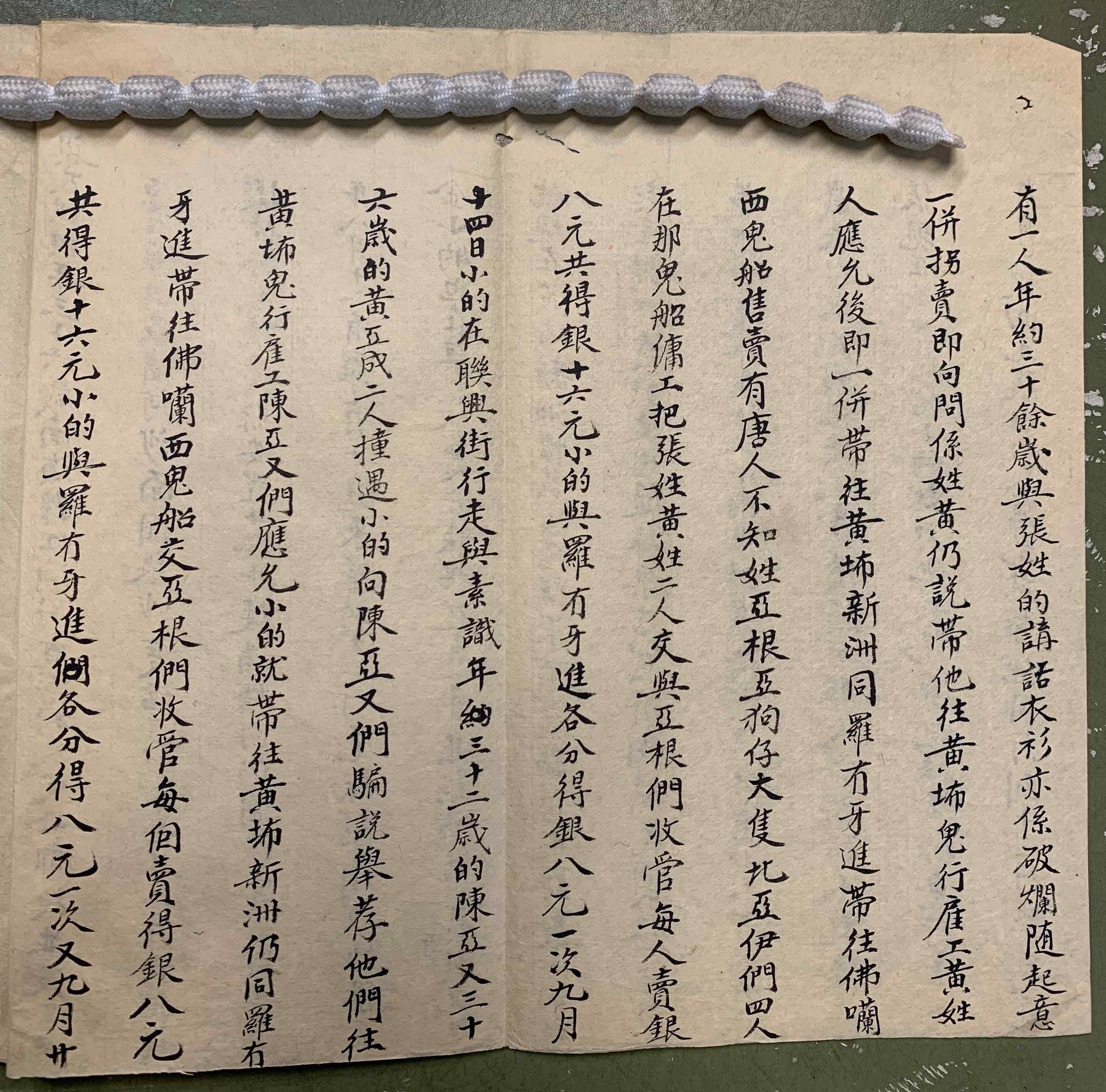
Confession of a kidnapper, p.2
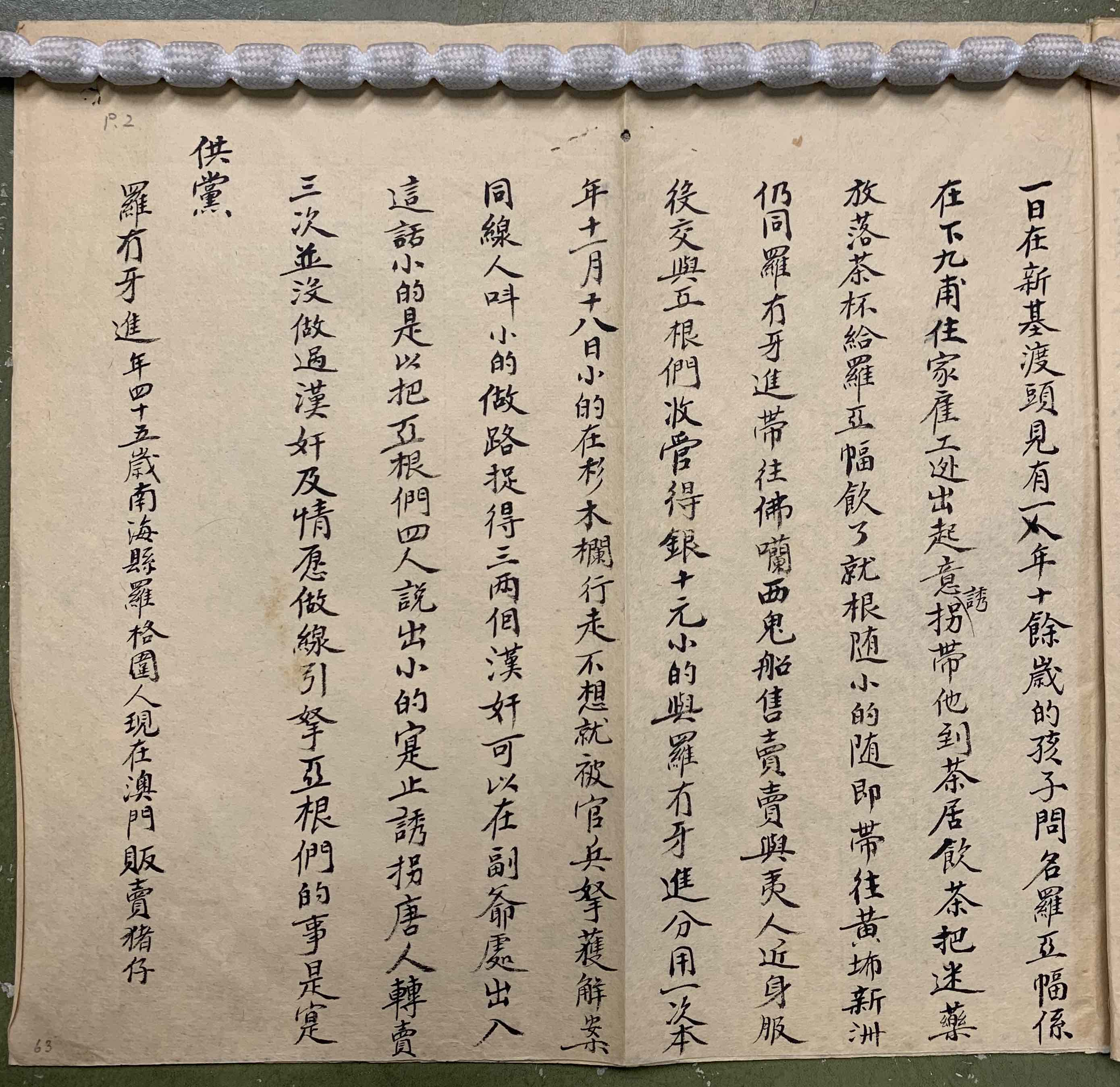
Confession of a kidnapper, p.3
Page 1 Transcript
南海縣正堂召為:訊供、遵、解事。 咸豐五年十一月二十日。 訊據:梁五,年三十六歲,係南海縣江浦司白蕉鄉人。父、母俱歿,並無兄弟。妻平日在沙面篩銀沙度日。 緣五於道光十六年,因夥劫被捉,發陸豐縣充徒。滿限回省,在十三行邊居住。 本年七月間,有金山人在五處坐談,因識羅有牙進。羅進向語:他在黃埔益宜店住,有賣豬仔利便路徑,要五夥誘。 五隨買楊柳花落迷藥備用。 七月初三日,在靜遠街撞見二十餘歲穿爛衫之張姓,誘以薦往黃埔洋行做工,每月銀圓四圓。又撞見三十餘歲之黃姓,一併誘至黃埔新洲。 同羅有牙進帶上法蘭西鬼船,交與夥計阿根、阿狗仔、大肢鼻、阿義門收下。 張、黃二人共賣銀十六圓,五與羅進平分。
Page 2 Transcript
八月初四日,在聯興街撞見: 陳阿友,年三十二歲; 黃阿成,年三十六歲。 亦誘薦往黃埔夷人行做工。帶上法蘭西鬼船,共賣銀十六圓,五與羅進平分。 八月十一日,在新基渡撞見: 羅阿福,年十歲。 係走失主家使喚幼童。五誘至茶居,將迷藥入茶,將該童迷倒。帶往黃埔賣與夷人使喚,得銀十圓。
Page 3 Transcript
十一月十八日,五在杉木欄行走,被官兵認捉解送。 以上夥誘賣人過洋三次,共五口。此外並無他情。 五並非漢奸。其羅有牙進,年四十五歲,現在澳門賣豬仔。 所供是實。
By Order of the Chief Magistrate of Nanhai County (南海縣正堂—Nanhai Xian Zheng Tang): Regarding the Interrogation, Confession, and Submission of the Case (訊供、遵、解事—Xun Gong, Zun, Jie Shi).
The record is dated December 28, 1855 (Xianfeng 5th Year, 11th Month, 20th Day—咸豐五年十一月二十日).
The deponent Liang Wu (梁五), aged 36, is a native of Baijiao Village (白蕉鄉) in the Jiangpu Division (江浦司) of Nanhai County (南海縣). His father and mother are both deceased, and he has no brothers. His wife, Ping-ri (平日), earns a living sifting silver sand at Shamian (沙面). Previously, in 1836 (Daoguang 16), he was convicted of robbery and exiled to Lufeng County, returning only last year. Upon arriving in the provincial city [Canton], he took up residence near the Thirteen Factories (十三行邊). In August 1855, a person from Gold Mountain (金山人) was at Liang Wu's residence sitting and talking, and it was there, near the Thirteen Factories (十三行邊), that he became acquainted with Luo "Buck-Teeth" Jin (羅有牙進).
Luo informed him that he worked at the Yiyi Store (益宜店) in Whampoa (黃埔) and that there was a profitable route for the trade of selling piglets (賣豬仔—mai zhu zai). Liang Wu then purchased stupefying drugs (迷藥—mi yao) made from the flowers of poplar and willow trees to facilitate kidnappings. On August 15, while on Jingyuan Street (靜遠街), he encountered a man in his early 20s named Zhang (張) who was wearing ragged clothes. He lured the man by promising him a position at a foreign firm (洋行—yang hang) in Whampoa that would pay 4 silver dollars (銀圓—yin yuan) a month. He then met a man in his 30s named Huang (黃) and lured both of them to Whampoa New Island (黃埔新洲).
He and Luo "Buck-Teeth" Jin (羅有牙進) took the two men to a French ship (法蘭西鬼船—Falanxi guichuan) and delivered them to the Chinese workers on board named Ah Gen (阿根), Ah Gou-zai (阿狗仔—Little Dog), Da-zhi-bei (大肢鼻—Big Nose), and Ah-yi-men (阿義門). The victims were sold for a total of 16 silver dollars, which the two accomplices split. On September 14, at Lianxing Street (聯興街), Liang Wu met Chen Ah-you (陳阿友) and Huang Ah-cheng (黃阿成) and used the same ruse of a job recommendation to bring them to the same French ship. They were likewise sold for 16 silver dollars and the money was split.
On September 21, at Xinji Ferry (新基渡), he encountered a 10-year-old boy named Luo Ah-fu (羅阿福) who had run away from his master's house. He lured the child to a teahouse (茶居) and placed the stupefying drug (迷藥) into his tea. Once the boy was unconscious, he was taken to Whampoa and sold to a foreigner (夷人—Yi ren) for 10 silver dollars to serve as a personal servant. On November 18, while walking at Shanmu-lan (杉木欄), Liang Wu was recognized and captured by government soldiers. He admits to the three instances of kidnapping and the sale of five people, but he explicitly denies being a Han traitor (漢奸—Han jian) or political collaborator. His partner, Luo "Buck-Teeth" Jin (羅有牙進), aged 45, is currently in Macau (澳門) continuing to engage in the trade of selling piglets.
AI assisted translation
Annotations
篩銀沙 = Shifting Silver Sand
This is a very specific occupation for his wife. Shamian was a major site for silver exchange and metallurgy; she was likely reclaiming silver particles from industrial or commercial waste.
佛蘭西鬼船
佛蘭西 = France / French
鬼船 = literally “devil ship,” a hostile Cantonese/South China expression for a foreign vessel
So 佛蘭西鬼船 is best rendered as “French foreign ship” or more simply “French ship.”
夷人近身服役
This phrase appears in connection with the boy Luo Wufu.
夷人 = foreigners, “barbarians” in older official/Sinitic usage
近身服役 = to serve in close personal attendance; essentially domestic or body-servant service
So the sense is that the child was sold for personal service to foreigners, not merely sold locally.
豬仔
Literally “piglets.” This was a well-known nineteenth-century South China term for kidnapped or trafficked Chinese labourers in the coolie trade. It is intentionally dehumanising, and the text reflects that.
金山的
It means “a Gold Mountain man” — someone associated with Gold Mountain, that is, the overseas goldfields world. Most likely California, though at tis date Victoria is also a possibility.
唐人
In this deposition 唐人 means Chinese people, not “Tang people” in any narrow dynastic sense. In South China usage it often simply means “Chinese.”
漢奸
The "Han Traitor" Denial: The phrase 並非漢奸 (is not a Han-jian) is a standard but vital legal defense of the era, as being labeled a political traitor carried a much harsher sentence than simple kidnapping.
楊柳花落
Poplar and Willow Flowers: This is more than just a sedative description; it refers to the "fluff" from these trees, which was historically used as a carrier for powdered drugs (likely datura or opium-based) blown into the faces of victims or mixed into tea.
使喚幼童
Shaved-head servant: The term suggests the 10-year-old boy was being sold into a specific type of domestic servitude where he would be identifiable by his haircut, likely within a foreign household in Whampoa.